
Staff Introduction
-
-
薗田 光太郎 Kotaro SONODA
- Emailkotaronagasaki-u.ac.jp- Position / Degree Institute of Integrated Science and Technology, Assistant Professor
School of Information and Data Sciences, Assistant Professor
Graduate school of engineering, Assistant Professor
Ph.D. on Information Sciences- Specialized Field Acoustic Information Hiding and Enrichment, Human Auditory Information Processing, Acoustic Signal Processing
CV
| 2005.3 | Ph.D. in Information Science, Tohoku University |
| 2005.4 – 2009.10 | Expert Researcher, Fundamental Security Group Team, National Institute of Information and Communications Technology |
| 2009.10 – | Assistant Professor, Graduate School of Engineering, Nagasaki University |
| 2013.3 – 2014.3 | Adam Mickiewicz University (Poland), Institute of Acoustics, Guest Researcher |
| 2014.12 – | Assistant Professor, Medical-Engineering Hybrid Professional Development Program, Graduate School of Biomedical Sciences, Nagasaki University |
Research Activities
Fundamental:Human Auditory Information Processing, Acoustic Information Coding
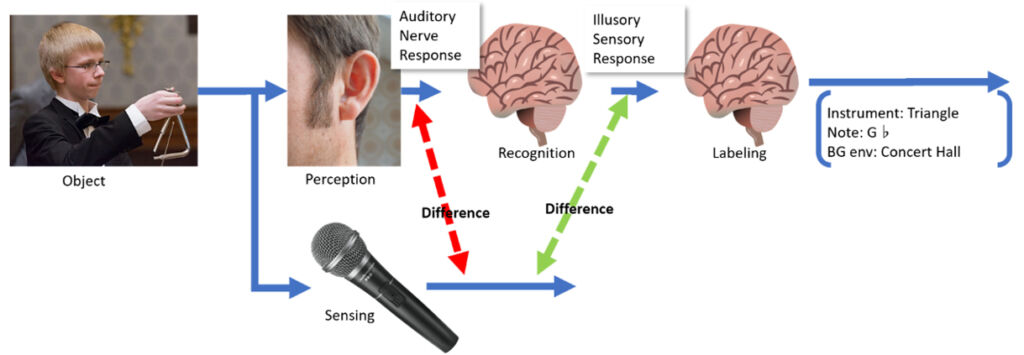
There are some sounds that are clearly different in waveform when recorded with a microphone, but when listened to with the ear, it is difficult to notice the difference.
-
-
- What kind of sound is it (or can it be made artificially)?
- What is the mechanism that prevents you from noticing the difference?
- Is this the limit of my hearing?
- Is the ear receiving the sound but creating an illusion in its later stages of brain processing?
-
Applied:Sound Enrichment, Sound Liveness Identification
Information Hiding, Digital Watermarking, Steganography
-
-
- Create sounds with embedding subliminal digital information. Embedded Information is detectable by machine microphone while human can’t notice it.
- Sound Enrichment, Side-channel.
- Information Security and Privacy.
-
Machine aided Sound Liveness Identification
-
-
- Due to the development of sound synthesis technology, it is not possible for the human ear to distinguish artificial spoofing of natural sounds.
- We need to develop a technique to detect artificial spoofing of natural sounds and to identify the liveness of the natural sounds.
-
Educational Activities
Class
Information and Data Sciences:Introduction to Programming, Practice in Software Programming II, Audio and Speech Engineering