
Staff Introduction
-

-
宮島 洋文 Hirofumi MIYAJIMA
- Emailmiyajimanagasaki-u.ac.jp- Position / Degree Institute of Integrated Science and Technology, Associate Professor
School of Information and Data Sciences, Associate Professor
Doctor (Engineering)- Specialized Field Machine Learning, Fuzzy Inference Method, Simple Secret Calculation, Parallel Processing- External Links researchmap
CV
| Mar.2010 | Hokkaido University, School of Engineering, Graduated |
| Mar.2012 | Osaka University, Graduate School of Information Science and Technology, Master Course, Completed |
| Sep.2013 | Osaka University, Graduate School of Information Science and Technology, Doctor Course, Left School |
| Aug.2015 | Nagasaki University, Graduate School of Biomedical Sciences, Researcher |
| Mar.2016 | Kagoshima University, Graduate School of Science and Engineering, Doctor Course (Early Completion) |
| Jul.2016 | Nagasaki University, Graduate School of Biomedical Sciences, Assistant Professor |
| Apr.2017 | Okayama University of Science, Faculty of Informatics, Lecturer |
Research Activities
A study on fast and secure concealment computation for edge computing
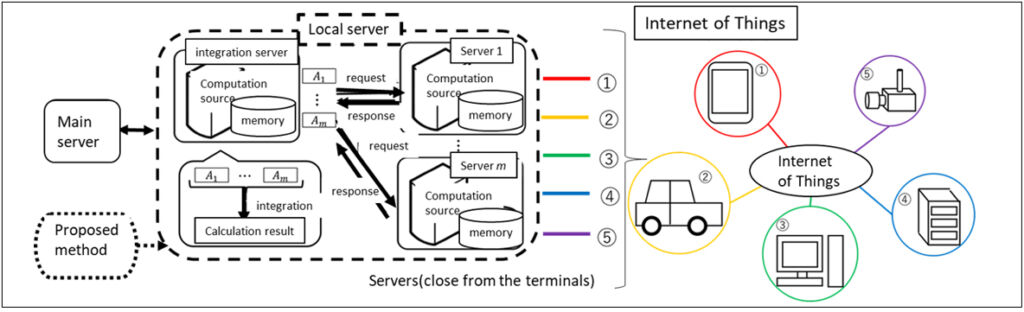
Society 5.0 aims to integrate cyber space with real space. In these days, with the huge amount of information, the real space is also shifting from the usual cloud system to the edge computing system for the Internet of Things (IoT). Then, what is machine learning suitable for edge computing? In this study, purpose of our research is to propose a system that executes learning while dividing data obtained from “things” into multiple servers. In other words, we propose and implement a system based on the idea of “division (distribution) of learning data + parallel computation = fast and secure learning method (suitable for edge computing)”.
Study on machine learning of fuzzy system
Much research has been done on machine learning that supports artificial intelligence (AI). In particular, neural networks (NN) such as CNN have received much attention from theory to application. NN can easily answer “what to do” to many problems, but it is difficult to answer “why do that”. This is the so-called “black box problem” of AI. The fuzzy system is one of the systems that realizes machine learning and answers such problems. We are studying new learning methods for this system. For example, consider the following problem in which a moving object arrives at a destination avoiding obstacles. The usual machine learning method gives a route for the answer, but it is difficult to answer “why do that”. The fuzzy system gives the following qualitative rules as a result of learning.

Educational Activities
Class
School of Information and Data Sciences:First-year Seminar, CalculusⅢ, Graph Theory and Optimization, Cognitive System A/B, Network Security, Research Project