
Staff Introduction
-
-
伊藤 宗平 Sohei ITO
- Emails-itonagasaki-u.ac.jp- Position / Degree Institute of Integrated Science and Technology, Associate Professor
School of Information and Data Sciences, Associate Professor
Graduate school of engineering, Associate Professor
Doctor (Engineering)- Specialized Field Software Engineering, Formal Methods, Systems Biology, Process Mining
CV
| Mar.2003 | Tokyo Institute of Technology, School of Engineering, Graduated |
| Mar.2005 | Tokyo Institute of Technology, Graduate School of Engineering, Master Course, Completed |
| Mar.2008 | Tokyo Institute of Technology, Graduate School of Engineering, Doctor Course, Completed |
| Apr.2008 | Tokyo Institute of Technology, Graduate School of Engineering, Research Associate |
| Apr.2012 | The University of Tokyo, Graduate School of Information Science and Technology, Research Associate |
| Apr.2013 | National Fisheries University, Department of Fisheries Distribution and Management, Assistant Professor |
| Oct.2016 | Silesian University in Opava, Czech Republic, Visiting Researcher |
Research Activities
Analysis of gene network by formal method
A gene network is a network that expresses the activation-inhibition relationship between genes. It is usually modeled with differential equations and analyzed by numerical simulations. However, such approach needs biological parameters, which are often unclear, and thus its applicability is limited. In this study, we consider a gene network as a reactive system (a system that responds appropriately while interacting with the environment) and describe its behavior qualitatively using linear temporal logic. We are studying methods for analyzing whether certain genes can be constantly expressed or oscillate, and whether certain functions are biologically homeostatics.
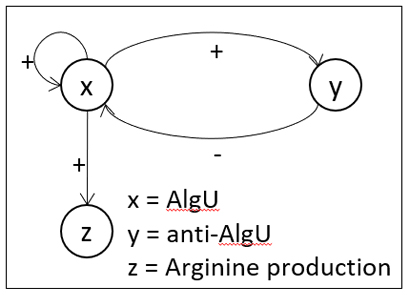
Gene network Example
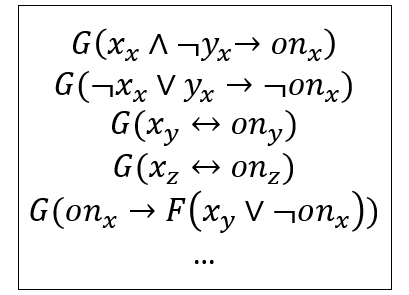
Behavioral description by linear temporal logic
Business process discovery and verification by process mining
Process mining is a method that uses data science techniques to find information useful for process improvement, such as business process workflow and relationships between personnel, from execution records (obtained from ERP such as SAP) of business processes. In this research, we are working on issues such as how to extract event logs from business processes, how to find formal models of business processes (models that can be mathematically executed), and how to verify whether business processes satisfy desired properties.

Educational Activities
Class
School of Information and Data Sciences:First-year Seminar, Compilers, Automata and Formal Language Theory, Operating Systems I/II, Programming LanguagesⅣ, Research Project
Graduate School of Engineering:Parallel and Distributed Processing